
By Lillian Shaw
Every year during Cedarville’s Homecoming Weekend, Cedarville’s freshmen engineering and computer science students construct a boat entirely made of packaging tape and coated paperboard that has to successfully cross Cedar Lake. This is both a fun challenge and one that encourages the engineers to think in diverse ways.
This year, the cardboard canoe race was postponed, due to high volumes of rain, to the following Friday, October 9. Although the Homecoming guests were not able to watch the race, the date change gave students visiting for CU Friday the opportunity to experience this Cedarville tradition.
Engineering and computer science students begin working on the design process for their boats through a new introductory course. Their dedicated construction of the boat goes on for about two weeks prior to the actual event.
Each group has between three to five students. All of the groups receive help from a peer advisor, an upperclass engineering or computer science student. The peer advisors meet every week with their group to help prepare the group for their own cardboard canoeing experience.
“We’re really proud of our upperclassmen who have stepped up to take on these leadership roles this semester,” David Dittenber, a professor of Civil Engineering and the canoe race’s organizer, said.
Caleb Hurley, a Mechanical Engineering major, was a peer advisor this year, and he enjoyed helping freshmen with their boats. Hurley encourages other upperclassmen to be a peer advisor.
“I believe it is a great opportunity to work alongside a fantastic group of multi-disciplinary technical majors,” Hurley said. “Not only that, this role gives students the chance to be mentored by intentional faculty as we pour into the freshmen and craft a meaningful introduction to engineering and computer science.”
The cardboard canoe race challenges students to learn how to communicate with their team effectively and handle situations in the best way possible.
“We want them to begin to see how the engineering design process involves not just creativity, but research, experimentation, communication, and planning,” Dittenber said.
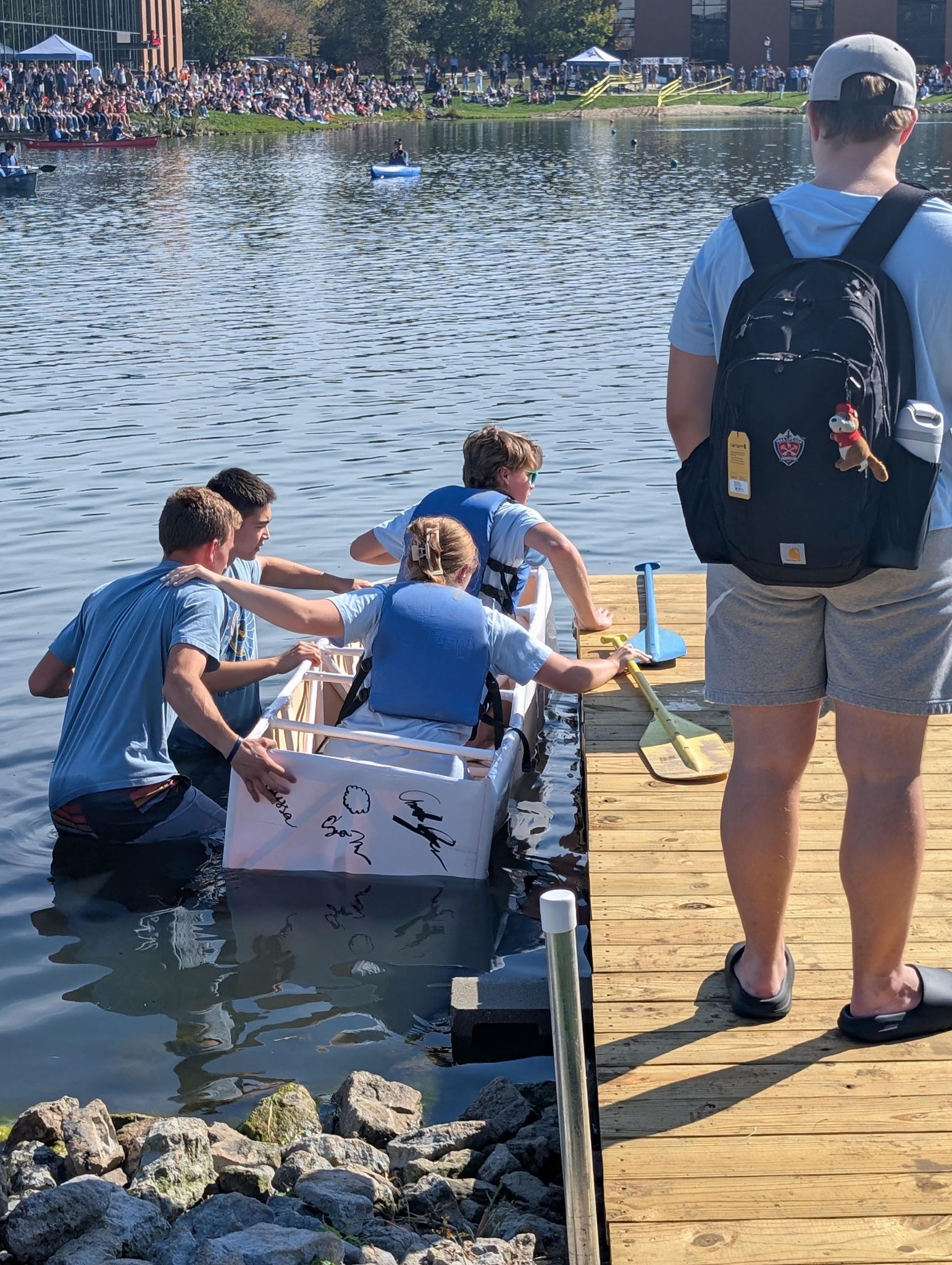
Many of the students had never built anything out of paper to the scale in which they did for this race. It took a lot of intentional thinking with their group members to choose the best approach.
“The hardest thing about constructing the boat was all the decisions. I don’t think people realize just how many different ways there are to build these boats. In engineering there’s so many different ways to do things and different opinions people have about the best way,” Alyssa Crowder, a Mechanical Engineering major said. “We were encouraged to ask others for advice and I got lots of varying opinions.”
Through the collaboration of engineering and computer science departments, students recognize the importance of computer science in a seemingly engineer-dominated challenge.
“This challenge also gave me an opportunity to learn about some of the ways computer science can benefit engineering,” Ian Neyanber, a Cyber Operations major, said. “For example, to help my team visualize our design, I created a scale model of the structure of our canoe in Blender 3D, a 3D computer graphics and animation program. I appreciated the chance to see how software like Blender can help in the engineering process.”
Many of the students who participated in the canoe race this year have offered advice for next year’s freshmen who take on this challenge.
“Be humble and willing to share your ideas and plans with an upperclassman with more
experience and listen to their feedback,” Geneva Stern, an Electrical Engineering major said.
“Don’t plan everything at the start. Plans will change as you are building and if you cut and roll everything at the beginning and your plan changes, you are left with wasted material,” Connor DeVore, a Mechanical Engineering major said. “This does not mean you should not have a direction in mind when you start, but you don’t want to limit yourself to that one plan.”
After the race is over, regardless of whether their boats successfully crossed Cedar Lake, students leave the race with a small taste of the challenges engineers face in the real world and memories that will last a lifetime.
Lillian Shaw is a sophomore Professional Writing and Information Design major. When she is not reading or writing, she enjoys hiking, painting, and being with family and friends.
No Replies to "Cardboard Canoe Race 2026: A deep dive into a long-standing tradition for the School of Engineering and Computer Science"